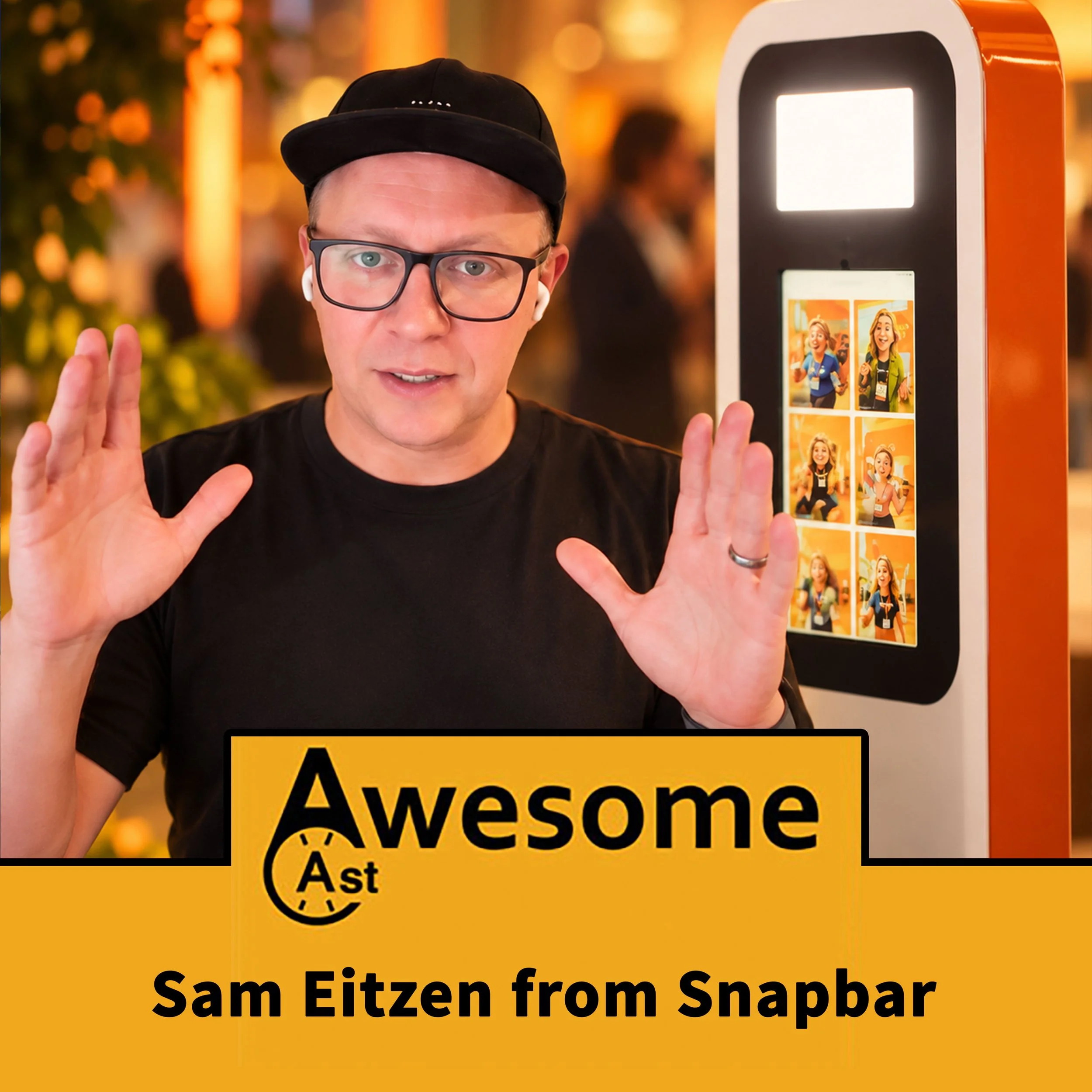
Awesome Chat: AI Event Marketing That Feels Human | Sam Eitzen from Snapbar
Artificial intelligence can turn someone into a superhero, an animated soccer player, or the star of a personalized story in seconds. But according to Snapbar CEO Sam Eitzen, making the technology work is only a small part of creating a good experience.
In this Awesome Chat, Michael Sorg and Katie Dudas sit down with Eitzen to explore how Snapbar has evolved from a traditional photo booth company into an experiential marketing platform—and what that transformation says about the changing event industry.
From Hauling Photo Booths to Building Software
Snapbar started 14 years ago as a side project for Sam and his brother. The business initially focused on weddings before shifting toward B2B events, conferences, trade shows, festivals, brand launches, and sporting events.
Then 2020 changed everything.
With physical events disappearing, one of Snapbar's clients asked whether its photo experiences could work online. The answer at the time was no—but the question inspired the team to build its first web-based product.
Instead of shipping cameras, lighting, cables, booths, and staff around the country, Snapbar began developing experiences that could live on the web.
Today, an activation might be running from an iPad inside a booth while simultaneously being available through a QR code to everyone at the event.
The AI Photo Booth Boom
When AI image generation began attracting attention, Snapbar started experimenting with it.
The early results were not exactly event-ready.
People might suddenly have additional arms, extra heads, or other visual problems familiar to anyone who experimented with early generative-image tools. For months, brands were intrigued by the technology but hesitant to deploy it.
Then the models improved.
AI photo booths became a major part of Snapbar's business, allowing brands to transform event attendees into characters or place them into worlds connected to a campaign.
But novelty doesn't last forever.
Consumers can now create AI images themselves, so Snapbar has continued experimenting with greater personalization. Its AI Stories product lets participants change pieces of the scenario before the image is generated, making each result more individual.
The Audience Matters More Than the Technology
One of the clearest lessons from Sam's experience is that an activation cannot simply be copied from one event to another.
A stylized soccer experience makes immediate sense around the World Cup. Gaming-inspired activations can resonate with cybersecurity audiences. Trading cards and fantasy aesthetics may work particularly well with certain technical communities.
Put that same experience in front of an entirely different audience, however, and engagement can disappear.
The technology isn't the strategy.
Understanding why someone would want to participate remains the strategy.
Reinventing the Trade Show Prize Wheel
Snapbar is also looking beyond photos and videos.
Sam describes a digital version of the traditional trade-show spinner wheel. Instead of hauling a physical wheel from event to event, a company could brand a digital wheel displayed on a screen.
Participants could interact through a touchscreen or control it from their phones. The system could track the number of prizes remaining, automatically remove a prize once inventory is exhausted, manage odds, capture leads, and provide redemption information.
It's an example of Snapbar's broader approach: identify a familiar event interaction and look for places software can make it easier for both the attendee and the marketer.
AI Still Needs Humans
Snapbar doesn't pretend that today's AI systems are perfectly predictable.
The company tests different image models, watches for regressions after model updates, adjusts prompts, and sometimes changes the model powering an activation.
A system can become better at one style while unexpectedly becoming worse at something else.
Sam compares working with AI to managing a new employee. You wouldn't necessarily hand a new person every credential and responsibility on their first day. You learn what they're good at, what needs oversight, and where mistakes can happen.
That's also why he cautions clients against thinking of generative AI as automated Photoshop. You can request an output, provide detailed instructions, test extensively, and create guardrails—but you still don't control every generated pixel.
AI Can't Manufacture Human Connection
One of the most interesting parts of the conversation comes when Katie asks what people expect AI to solve at events that may not actually be so simple.
Sam's answer is networking.
Conference attendees want professional value, but they also want connection. The tempting solution is an AI matchmaking system that analyzes everyone's interests, profession, hobbies, and location and determines who should meet.
But two people both liking cigars doesn't automatically mean they should be friends or business partners.
Context matters.
AI may improve networking systems, but simply feeding attendee data into a model isn't the same thing as understanding why two human beings should actually talk to each other.
AI Makes Building Easier—Not Business Easier
Sam ends the conversation with a warning for entrepreneurs excited about how quickly AI can turn an idea into a working product.
If something is easy for you to build with AI, it's probably easy for thousands of other people to build too.
That means the product itself may no longer be the hardest part.
Distribution becomes the advantage.
Who knows you? Who trusts you? Who sees your launch? Who is already paying attention? Can people find your company through search? Do you have existing customers who will listen when you announce something new?
AI may change the tools, but it doesn't eliminate the fundamentals of building relationships and finding customers.
And that may be the most useful takeaway from the entire conversation: the future of experiential marketing isn't simply about making experiences more artificial.
It's about using better technology to create experiences that still feel human.
Learn more about Snapbar at https://snapbar.com.