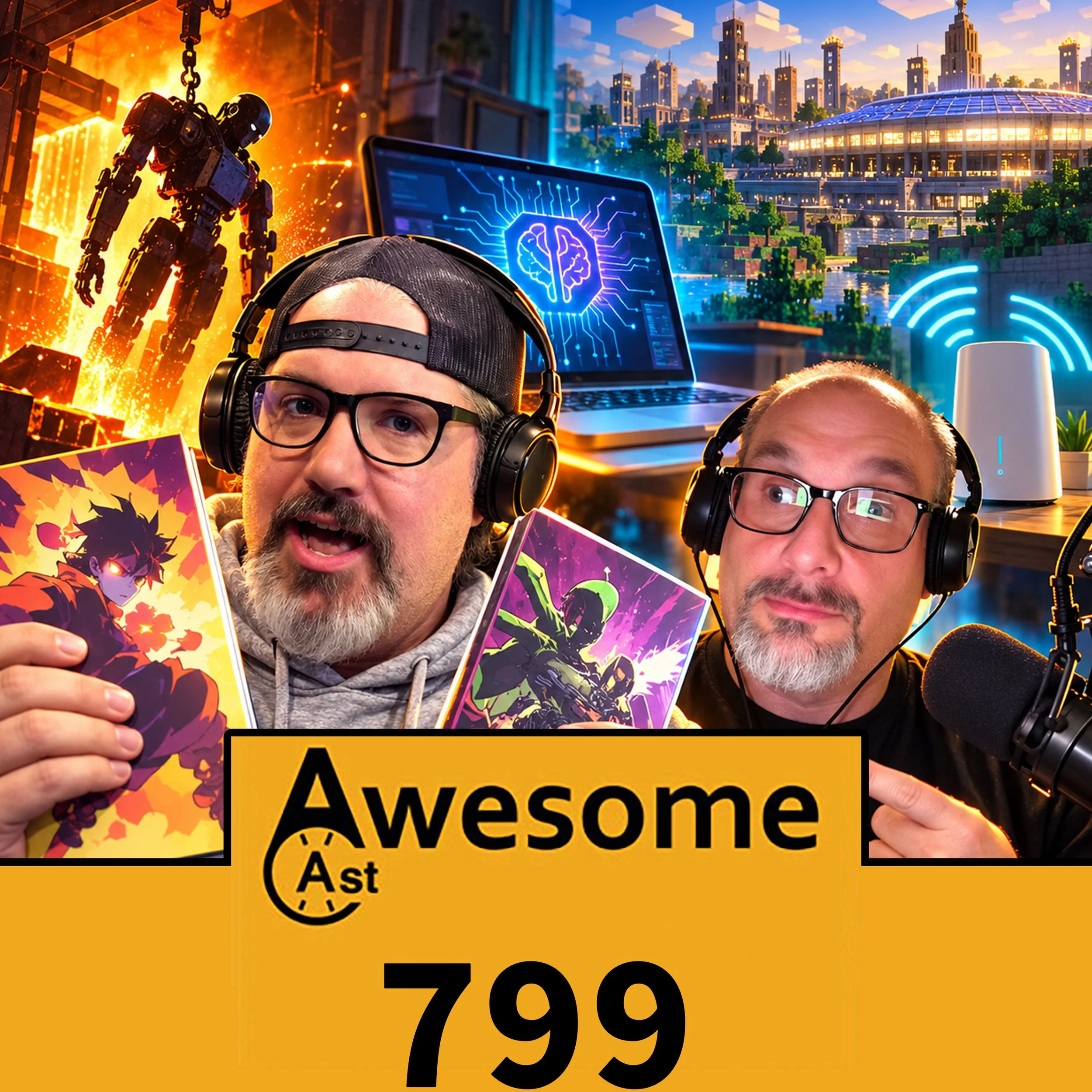
AwesomeCast 799: Running AI at Home, 5G Internet and Mike Tomlin’s Minecraft City
What happens when a technology podcast jumps from running AI on a Mac to replacing cable internet with 5G, then somehow ends up inside Mike Tomlin’s extremely elaborate Minecraft city? You get AwesomeCast 799.
Sorg and Dave Podnar are together this week for a show filled with experiments, unexpected hobbies, strange robots, gaming news and the usual assortment of technological rabbit holes. Sorg starts exploring what it actually takes to run modern AI models locally instead of depending entirely on ChatGPT, Gemini or another cloud service. Dave, meanwhile, is conducting a very practical experiment: can AT&T Internet Air handle everything his household normally throws at wired broadband?
And yes, Mike Tomlin apparently has enough Minecraft architecture for a nearly 20-minute tour — with “Episode One” at the beginning.
Awesome Things of the Week
Dungeon Crawler Carl Gets Another Physical Volume
Sorg’s first Awesome Thing is Volume 2 of the physical Dungeon Crawler Carl comic adaptation.
The material has already been available digitally in a serialized format, but Sorg has been collecting the printed editions. He digs into the art style, how the physical volumes divide the original story, the wonderfully bizarre goblin-and-llama storyline, and a cliffhanger involving one especially memorable character design.
Dave Tries AT&T Internet Air
Dave and Ruth went looking for ways to cut their combined phone and home internet costs and discovered an AT&T 55+ option that included access to home internet service.
Getting signed up was more complicated than expected. A long phone wait led to an unsuccessful store visit before they eventually found much better help at AT&T’s Monroeville location.
The resulting Internet Air setup is essentially cellular home internet through a combined 5G modem/router. Dave says setup was extremely easy: plug it in, connect to Wi-Fi and position it somewhere with a good cellular signal.
More importantly, he was actively using it during AwesomeCast. With television streaming downstairs, phones, cameras and the podcast itself using the connection, the system was holding up well. Dave reported download results in roughly the 400 range, though uploads were considerably slower — an important concern when live video is part of the household business.
For Dave’s household, the potential savings are substantial. He estimates their previous internet and mobile combination at around $260, with the new setup potentially cutting that roughly in half.
AT&T Internet Air:
https://www.att.com/internet/internet-air/
Can You Run Your Own AI Instead?
Sorg has been experimenting with moving some AI work away from giant cloud services and onto computers he already owns.
One reason is cost. AI services are increasingly built around tokens and expensive computing resources, and Sorg expects the current era of inexpensive “all you can eat” AI subscriptions to keep changing as providers figure out what heavy users actually cost them.
The other reason is control.
Instead of sending everything to a remote provider, what if a creator or small business could run a useful model locally?
Sorg demonstrates LM Studio running on his M1 Pro MacBook and talks about using Qwen 3.5 as one of his starting models. LM Studio makes it possible to download models directly and experiment with them without needing to build the entire software environment from scratch.
The tradeoff becomes immediately obvious: cloud systems such as ChatGPT already know a lot about Sorg’s workflows and can reach outside services. A fresh local model knows essentially nothing about AwesomeCast, iPhoneography or Sorgatron Media until it is given that information.
Dave downloads LM Studio during the segment and begins experimenting with a model on his own MacBook. When he asks it for information that would normally be easy for a cloud-connected AI system, he quickly discovers the limitations of a local system trying to reach websites that block automated access.
But the potential is what excites Sorg.
One future experiment would be dedicating a computer to internal podcast analytics. Instead of manually downloading CSV files every week, a local system could potentially gather authorized data, process it, create reports and keep the entire analysis workflow inside the studio.
As Sorg puts it:
“Don’t data center me, bro.”
Awesome History: Adriana Ocampo
Dave’s Awesome History segment highlights planetary geologist Adriana Ocampo.
Born in Colombia and raised in Argentina, Ocampo moved to the United States as a teenager and found an opportunity to get involved with NASA’s Jet Propulsion Laboratory while still young. She attended Pasadena City College before transferring to Cal State LA and earning a geology degree.
Her career included work connected to identifying the Chicxulub impact crater — the enormous impact structure associated with the event that wiped out the dinosaurs.
She later became involved with NASA’s New Frontiers program, which focuses on ambitious planetary science missions while trying to keep missions focused enough to launch more frequently.
The conversation also turns to the discouragement Ocampo encountered because geology was viewed as a field for men. Dave connects that history to his own engineering education and Sorg recalls similar stories from his mother’s experience in drafting.
Adriana Ocampo profile:
https://roadtripnation.com/leader/adriana-ocampo-uria
ChachiSays Video Game Minute
Chachi packs three gaming stories into this week’s minute.
GTA 6 Gets Bigger and Stormier
The segment discusses reports that GTA 6’s map will be significantly larger than GTA 5 and that weather systems including hurricanes and tropical storms can move across the world.
Miami Becomes Vice City
Rockstar and the Miami Heat are teaming up for a Vice City-themed game featuring a special court, uniforms and merchandise.
Pennsylvania Wants to Protect Abandoned Games
Pennsylvania Senator John Kane has proposed the Protect Our Games Act. The proposal discussed in the segment would require publishers shutting down online games to offer options such as offline support, an independent server patch or a minimum refund, along with advance notice.
Robots Get a Terminator 2 Sendoff
Sorg finds possibly the most metal robot-retirement program imaginable.
A video involving humanoid robots shows them being decommissioned at a foundry in a sequence deliberately evoking the end of Terminator 2. The robots descend toward the foundry, Arnold makes an appearance, and the company apparently even taught robots flips and dives for the occasion.
https://www.youtube.com/watch?v=pfAh5oQDPDM
The stranger part?
Sorg discovered the video because the AI-generated entertainment host built into his ad-supported Telly television told him about it.
An AI presenter telling Sorg about robots performing their own Terminator-inspired destruction was almost too perfectly on-brand.
Mike Tomlin Has a Massive Minecraft City
And then the show discovers Mike Tomlin’s Minecraft world.
A video tour running nearly 20 minutes shows an elaborate digital city Tomlin originally began building while playing Minecraft with his children — and then apparently continued long after they stopped.
There are buildings with carefully considered lighting, aquariums, a stadium and enough architecture for Tomlin to explain why he made specific design choices.
Then Dave notices the most important detail:
The video says “Episode One.”
The hosts joke about whether Tomlin’s Minecraft timeline correlates with the Steelers’ playoff record, but ultimately admire the commitment behind the project.
Sorg’s verdict:
“Yo, Mike Tomlin, whatever makes you happy, brother.”
https://www.facebook.com/reel/1143287255011071
The discussion naturally spirals into SimCity, Pocket City, SimCopter and the appeal of spending hours building digital cities.
One More Strange New World
Before wrapping up, Sorg also gets into the delightfully strange recent run of Star Trek: Strange New Worlds, where wildly different genre episodes can sit beside traditional Star Trek stories.
Support the Show
Watch and listen to more AwesomeCast at SorgatronMedia.com.
Patreon supporters also get additional Aftertalk beyond the public episode, including two more visual-tech rabbit holes that didn’t make the main show.