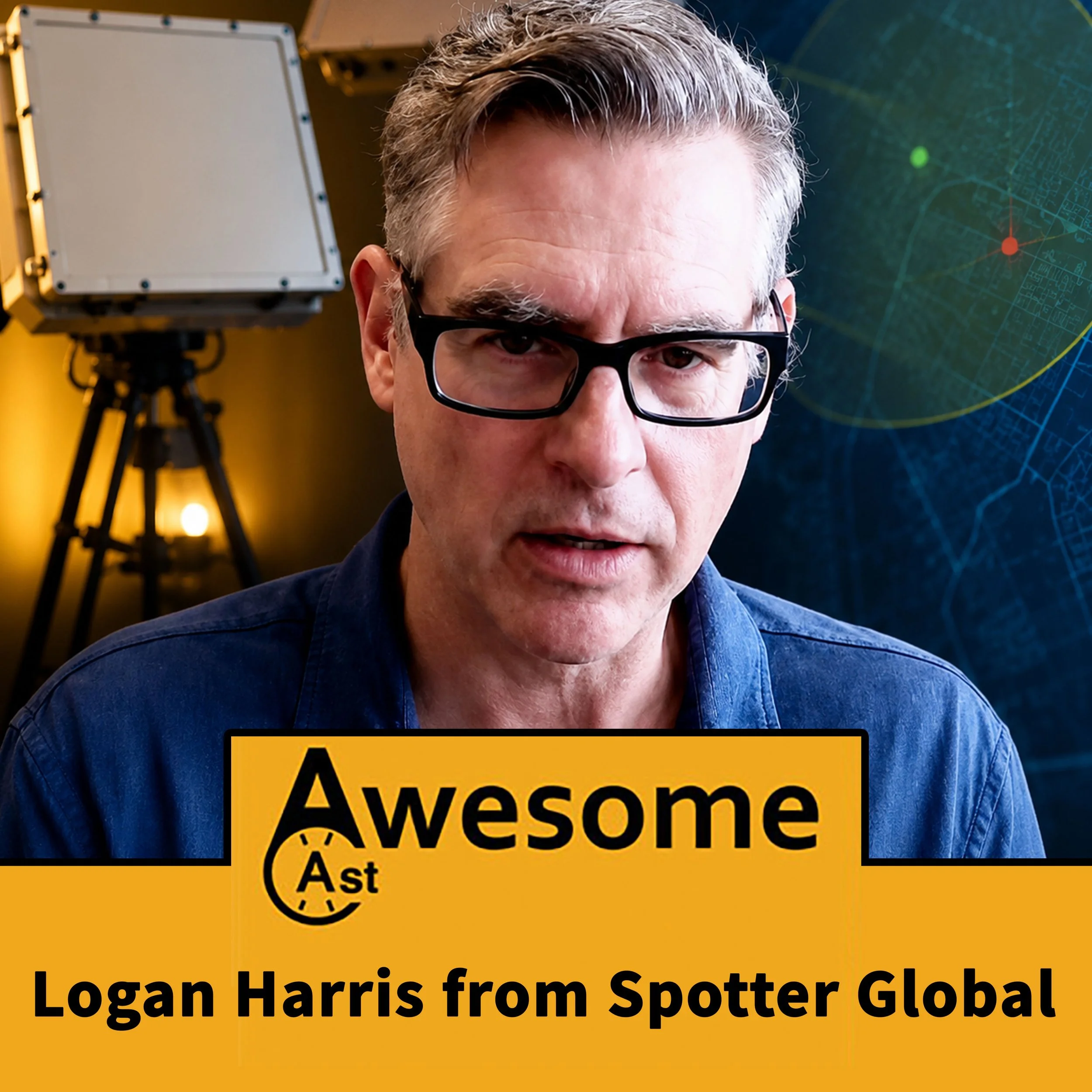
Awesome Chat: Spotter Global
Drones are great when they are taking photos, inspecting buildings, competing in engineering projects, or putting on a show.
But what happens when one appears somewhere it should not be?
That question is becoming increasingly important as inexpensive consumer drones become more capable and specialized drone technology continues to evolve. On this AwesomeChat, Sorg sits down with Logan Harris, CEO of Spotter Global, to explore how radar and other technologies can help answer a deceptively difficult question:
What exactly is moving out there, and who is controlling it?
Taking Radar From 100 Pounds to a Compact Sensor
Spotter Global began with military applications.
Logan explains that traditional ground-surveillance radar systems could weigh around 100 pounds, require a crew of several people, and need substantial power. The challenge was to create something much smaller that could give small teams situational awareness in remote locations.
That challenge ultimately became Spotter Global.
During the conversation, Logan demonstrates a compact radar capable of monitoring a large area while consuming only a small amount of power.
But detecting movement is only the beginning.
Turning “Something Moved” Into Useful Information
Anyone with a modern security camera has probably experienced a notification announcing that something moved—only to discover that it was a branch, shadow, or other harmless activity.
Spotter approaches that problem in layers.
Radar provides wide-area coverage and tracking information. A camera can then be directed toward the detected target. Video analytics add another level of classification and confirmation.
Logan also demonstrates SnapTrack, a Spotter Global feature that places live target imagery directly alongside its position on a map.
Instead of watching numerous separate camera feeds, an operator can see targets, locations, and available video in a single situational-awareness interface.
Protecting Infrastructure Beyond the Fence
The technology eventually expanded from military applications into critical infrastructure.
Logan discusses the 2013 attack against California’s Metcalf electrical substation and how incidents like it demonstrated that a fence alone may not provide sufficient protection for facilities where threats can originate hundreds of yards away.
Radar gives operators the ability to look beyond that perimeter.
That same concept can apply to electrical infrastructure, data facilities, public events, and other locations where knowing that something is approaching can be more valuable than discovering it once it has already reached the fence.
Finding Drones—and Sometimes Their Pilots
One of the most fascinating parts of the conversation is Remote ID.
Logan compares Remote ID to a license plate for a drone. Compatible aircraft broadcast identifying and location information that can be received by equipment on the ground.
During the interview he demonstrates tracks around Spotter Global’s Utah office, including the location of aircraft and their operators.
That can become especially valuable when drones appear around major public gatherings.
Logan describes a Fourth of July fireworks event where four drones flew around or over a stadium containing roughly 50,000 people. Law enforcement was ultimately able to intercept two of the operators.
The technology changes the question from “Is there a drone up there?” to “Where is the drone going, and where is the pilot?”
DJI, Geofencing, and the Difference Between Warning and Prevention
Sorg and Logan also discuss DJI’s approach to restricted flight areas.
Previously, DJI’s software could prevent a drone from taking off or entering certain geofenced locations. Logan explains that the system has shifted toward warning pilots rather than always physically preventing the flight.
That difference matters.
A warning depends on the pilot following it. Detection technology gives security and public-safety teams another way to know when someone does not.
What About DIY Aircraft?
The conversation connects naturally to Sorg’s experience covering SAE Aero Design, where engineering students construct RC aircraft and increasingly experiment with drone technology.
Logan demonstrates an external Remote ID beacon that can be attached to a DIY aircraft when required.
As drones expand beyond ready-to-fly consumer products, technologies like these become increasingly important for integrating custom aircraft into a world of evolving aviation rules and public-safety expectations.
Fiber-Optic Drones Change the Detection Problem
Then the conversation takes a very different turn.
Logan describes the growing use of fiber-optically guided drones, or what he calls “FOG drones.”
Most people picture a drone communicating wirelessly with its controller. Fiber-optic drones instead trail an extremely thin cable between the aircraft and operator.
Video and commands travel through the fiber.
That means there may be no conventional radio-frequency control signal to detect or jam.
For security systems built around finding wireless signals, that fundamentally changes the problem. Physical detection technologies such as radar become much more important.
The Economics of Stopping Cheap Drones
That challenge extends to larger long-range attack drones.
Logan highlights one of the biggest problems in modern counter-drone technology: the cost of the response.
An inexpensive aircraft can create a very expensive security problem. Using a defensive system costing millions of dollars to destroy a drone costing only tens of thousands of dollars may work tactically, but it is difficult to sustain economically.
Detecting, identifying, and responding appropriately to different kinds of aircraft is becoming its own technological arms race.
Radar for Fish Farms, Avalanches…and Polar Bears
Not every Spotter Global application involves warfare or rogue drones.
Some of the most interesting uses are ones Logan never expected when the company started.
Fish farms can contain millions of dollars in stock, making unauthorized approaches a potentially expensive security problem.
Radar has also been applied to avalanche monitoring and rockfall detection.
And perhaps the most unexpected example: polar bears.
Logan points to radar being used as part of efforts to detect and track polar bears, illustrating how technology created for battlefield situational awareness can evolve into a general tool for understanding movement across large areas.
Logan Harris’s Biggest Entrepreneurship Lesson
The conversation closes by stepping away from radar and drones.
Logan says entrepreneurs should be building something for more than money because of the work, pressure, and stress involved.
He also shares a framework he calls the Three Rs: Record, Remind, Report.
Record what needs to happen.
Create reminders so it does not disappear.
Report on whether it happened.
It is a simple concept, but Logan says consistently completing the small things is what ultimately allows a company to accomplish the big things.
From protecting special operations teams to watching electrical infrastructure, tracking drones, monitoring avalanches, and spotting polar bears, Spotter Global offers a fascinating example of how solving one difficult engineering problem can lead to applications nobody originally expected.
Learn more about Logan Harris and Spotter Global at www.spotterglobal.com.