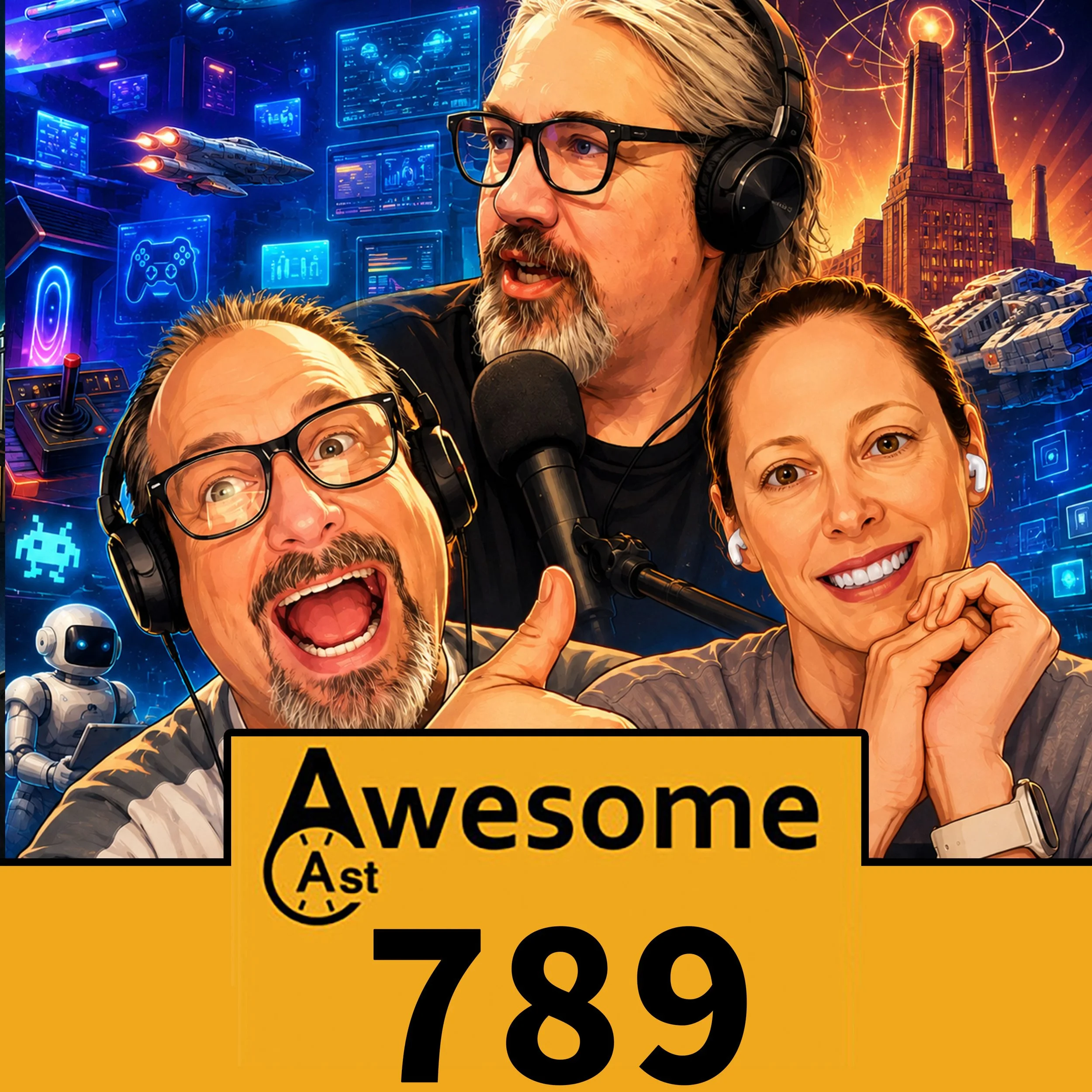
AwesomeCast 789: AI Graphics Get Smarter + Xbox Classics on PC & LEGO Star Trek
How do you preserve technology from the past while figuring out what technology should—and shouldn’t—do next?
That question runs through a surprising amount of AwesomeCast 789 as Sorg, Katie Dudas, and Dave Podnar jump from a massive piece of Pittsburgh scientific history to AI-assisted Photoshop workflows, Xbox game preservation, interactive LEGO, transforming robots and a school district considering a humanoid assistant.
Saving Pittsburgh Technology History
Dave starts with Westinghouse’s Atom Smasher, built in 1937 for early atomic research.
The structure has been sitting on its side since 2015 and showing the effects of time, but plans call for it to be carefully disassembled, moved and restored. For Dave, the story is bigger than one giant piece of scientific equipment.
Technology moves quickly, and the rush toward whatever comes next often means nobody stops to preserve the tools, experiments and infrastructure that made the next generation possible. The Atom Smasher provides a physical reminder of the slow, fundamental research behind technologies we eventually take for granted.
Katie has another enormous Pittsburgh project on her mind: the Commercial Street Bridge near the Squirrel Hill Tunnel.
The replacement process involved building a new bridge nearby, demolishing the old structure and moving the replacement into position. Pittsburghers watched the process through live cameras and time lapses while dealing with the traffic disruptions that came with it—and somehow, the project wrapped ahead of schedule.
There was even time for a marriage proposal on the construction site.
Using AI Without Giving Up Control
Sorg’s Awesome Thing of the Week is more of an Awesome Tip.
Generative AI can quickly create a graphic concept, but continuing to regenerate the entire image every time something needs changed can introduce new problems. Faces change. Text gets mangled. Fonts look suspiciously “AI.” Something that looked right two prompts ago suddenly falls apart.
So Sorg has started treating AI output as the beginning of the process instead of the finished product.
He demonstrates asking ChatGPT to break a design into transparent components that can be brought into Photoshop. From there, original photography can replace generated versions, typography can be rebuilt, and individual elements can be changed without asking AI to recreate everything.
AI is also useful for reverse-engineering the look of a graphic. Sorg has been using it to identify fonts, explain effects and even give step-by-step guidance for recreating a look with Photoshop tools such as Camera Raw.
The result is less “AI made this graphic” and more “AI helped me figure out how to make this graphic.”
Audiobooks Started With Accessibility
Dave shifts the conversation to the history of audiobooks and a technology that became mainstream after beginning as an accessibility tool.
Recordings of books were developed to give blind and visually impaired people another way to access written material. Those early recordings evolved from records to tapes, CDs, portable digital players and eventually services such as Audible.
Today, listening to a book during a commute, workout or road trip feels completely ordinary.
That makes audiobooks another example of accessibility work producing technology that eventually benefits a much larger audience.
The conversation even connects that history to the current Dungeon Crawler Carl phenomenon, where audiobook performances have become such an important part of the experience that the voices themselves are following the property into other media and merchandise.
Chachi’s Video Game Minute
Chachi brings another burst of gaming news.
Hasbro reportedly took a $56 million hit after canceling several unannounced game projects. Steam Deck orders reportedly dropped sharply after a price increase. Microsoft is moving Xbox backward compatibility toward PC and handheld devices.
And Universal has a deal involving ten Atari game properties.
That last one gives the AwesomeCast crew perhaps the most important question of the episode:
What exactly is a Pong movie?
Xbox Looks Back to Move Forward
The backward-compatibility story continues after Chachi’s segment as Sorg dives into Microsoft bringing original Xbox games to PC.
Titles discussed include Blinx, Fuzion Frenzy, Crimson Skies and Conker: Live & Reloaded.
For Sorg, the interesting part isn’t simply another way to sell old games. It’s evidence that Xbox continues to invest in preserving its back catalog as its larger gaming strategy changes.
That leads to some hands-on nostalgia about going back to older generations of games.
Sometimes the biggest obstacle isn’t the graphics. It’s remembering how anyone navigated these games in the first place.
Old control schemes, N64 button layouts, unclear objectives and tiny visual clues can make revisiting a classic as much an archaeology project as a gaming session.
Jem Meets Transformers
AwesomeCast has seen plenty of questionable franchise crossovers.
Transformers and Jem and the Holograms, however, gets Katie’s approval.
The Autobot Blaster crossover embraces the Jem aesthetic, complete with a keytar and cassette characters. That leads into even more Jem discussion, including the original singing voice still performing the songs and the franchise continuing to find new life decades after its original run.
Sometimes nostalgia mashups make sense after all.
LEGO Goes to the Final Frontier
LEGO Smart Play is heading to Star Trek with a USS Enterprise bridge set inspired by the original series.
The technology uses interactive components and figures to trigger responses, creating a more dynamic LEGO experience than simply building and displaying the model.
Naturally, the possibility of combining Star Trek and Star Wars LEGO leads to the kinds of cross-franchise situations the internet was built to argue about.
The discussion even wanders into Doctor Who references in Star Trek: Strange New Worlds and whether the show is trying to tell fans something bigger about its universe.
Optimus Prime Can Traumatize You All Over Again
Robosen has already built transforming robotic versions of familiar Transformers characters.
Now it has Fallen Leader Optimus Prime.
The robotic collectible features dialogue from Peter Cullen, interactive movement, transformation, the Matrix of Leadership and the ability to recreate classic scenes with other Robosen Transformers.
Yes, that includes that scene.
Apparently watching Optimus Prime die once during childhood was not enough. Technology has finally advanced enough to recreate the experience in your own home.
Progress!
Does the Classroom Need a Humanoid Robot?
The episode ends with technology that inspires a very different reaction.
A New York school district paused plans involving a $58,000 humanoid robot after the project drew significant backlash.
The proposed robot was intended as a classroom helper, but the crew questions the economics of spending that much on a robotic assistant when schools already need additional teachers and human support.
There are also concerns about children interacting with AI, the community selected for the pilot, and the robot company’s history.
It becomes a larger conversation about how organizations adopt technology: who gets excited about the pitch, who actually has to use the technology every day, and whether the people closest to the problem were included before somebody signed off on the shiny new solution.
That may be the biggest lesson from AwesomeCast 789.
Technology can preserve history. It can make creative work easier. It can open books to new audiences, preserve games for future generations and put a tiny USS Enterprise on your desk.
But “we can do this” and “we should do this” remain two very different questions.